And this list was released last Tuesday, 21 October 2008:
http://www.moh.gov.bn/news/20081021a.htm


(image from The Internet)
PENARIKAN BALIK KE ATAS PRODUK BISKUT BERJENAMA KHONG GUAN DAN KHIAN GUAN
(16 Ramadan 1429H / 17 Oktober 2008M)
KELUARAN NEGARA MALAYSIAKementerian Kesihatan Negara Brunei Darussalam ingin memaklumkan kepada orang ramai bahawa produk biskut berjenama Khong Guan dan Khian Guan keluaran Negara Malaysia ditarik balik dari pasaran kerana dicemari dengan bahan melamine.
Siaran Akhbar ini dikeluarkan berikutan dengan penarikan balik oleh Kementerian Kesihatan Malaysia ke atas produk-produk keluaran daripada kilang-kilang Biskut Khong Guan, Johor dan Khian Guan, Pulau Pinang yang mana didapati menggunakan agen penaik ammonium bicarbonate keluaran Negara China yang dicemari oleh melamine.
Agen penaik ammonia bicarbonate adalah bahan yang biasanya digunakan dalam pembuatan biskut dan dibenarkan di bawah Peraturan-Peraturan Kesihatan Awam (Makanan) (P1 Penggal 182). Memandangkan ianya dicemari oleh bahan melamine maka ianya tidak selamat digunakan.
Produk-produk terbabit adalah seperti berikut:
Khong Guan Biskut Soda keluaran Negara Malaysia.
Khong Guan Biskut Lemon Puff keluaran Negara Malaysia.
Khong Guan Biskut Lemon Pof keluaran Negara Malaysia
Khong Guan Biskut Butter Cream keluaran Negara Malaysia.
Khong Guan Biskut Baby Fish keluaran Negara Malaysia.
Khong Guan Biskut Healthy Cracker keluaran Negara Malaysia.
Khong Guan Biskut Cocoa Puff keluaran Negara Malaysia.
Khong Guan Biskut Sandwich Oren keluaran Negara Malaysia.
Khong Guan Biskut Family Crackers keluaran Negara Malaysia.
Khong Guan Biskut Bentuk Binatang keluaran Negara Malaysia.
Khong Guan Biskut Tunjuk (Rokok) keluaran Negara Malaysia.
Khong Guan Biskut Mini Puff keluaran Negara Malaysia.
Khian Guan Biskut Creamy Chocolate keluaran Negara Malaysia.
Khian Guan Biskut Lemon Puff keluaran Negara Malaysia.
Khian Guan Biskut Square Puff keluaran Negara Malaysia.
Khian Guan Biskut Cocoa Puff keluaran Negara Malaysia.
Khian Guan Biskut Jagung Puff keluaran Negara Malaysia.
Khian Guan Biskut Campuran (Party) keluaran Negara Malaysia
Berikutan dengan ini, Jabatan Perkhidmatan Kesihatan melalui Bahagian Kawalan Kualiti dan Keselamatan Makanan telahpun menghubungi pengimport produk berkenaan dan telahpun diarahkan untuk menarik balik kesemua produk terbabit termasuk yang dijual bercurai atau bertimbang mahupun yang di bungkus semula dari pasaran. Disamping itu juga, sebagai langkah berjaga-jaga, Kementerian Kesihatan terus memantau bagi mempastikan produk-produk terbabit tersebut diatas, produk susu dan tenusu serta produk yang telah disenaraikan mengandungi bahan melamine keluaran Negara China tidak ada dipasaran dan tidak di import ke negara ini.
Sehubungan dengan ini, Kementerian Kesihatan menasihatkan agar:
Para pengimport dan peniaga menarik balik produk-produk terbabit (jika ada) dari pasaran dan menyerahkannya ke Bahagian Kawalan Kualiti dan Keselamatan Makanan, Jabatan Perkhidmatan Kesihatan atau Pejabat-Pejabat Kesihatan di daerah-daerah untuk tindakan lanjut; dan
Para pengguna yang memiliki produk-produk terbabit untuk menggembalikan (jika ada) ke kedai-kedai dimana produk tersebut dibeli atau menyerahkannya ke Bahagian Kawalan Kualiti dan Keselamatan Makanan, Jabatan Perkhidmatan Kesihatan atau Pejabat-Pejabat Kesihatan di daerah-daerah.
Kementerian ini juga memaklumkan sepertimana yang diperuntukkan dibawah Bab 9 ceraia (1subperenggan (i) Akta (Kesihatan Awam) (Makanan), (Penggal 182) sesiapa yang menyediakan, menjual atau mengimport makanan yang boleh memudaratkan kesihatan boleh dipenjara selama 5 tahun atau suatu denda atau kedua-duanya sekali.
Sebarang pertanyaan dan keterangan lanjut bolehlah menghubungi:
Bahagian Kawalan Kualiti dan Keselamatan Makanan
Perkhidmatan Kesihatan Alam Sekitar
Jabatan Perkhidmatan Kesihatan, Kementerian Kesihatan
Jalan Delima Dua, Berakas BB2313
Nombor telefon : 2 33 1100-5 / 6 / 8 / 9 / 10
Nombor Faksmili: 2 331107
Alamat e-mel: fsqc@moh.gov.bn
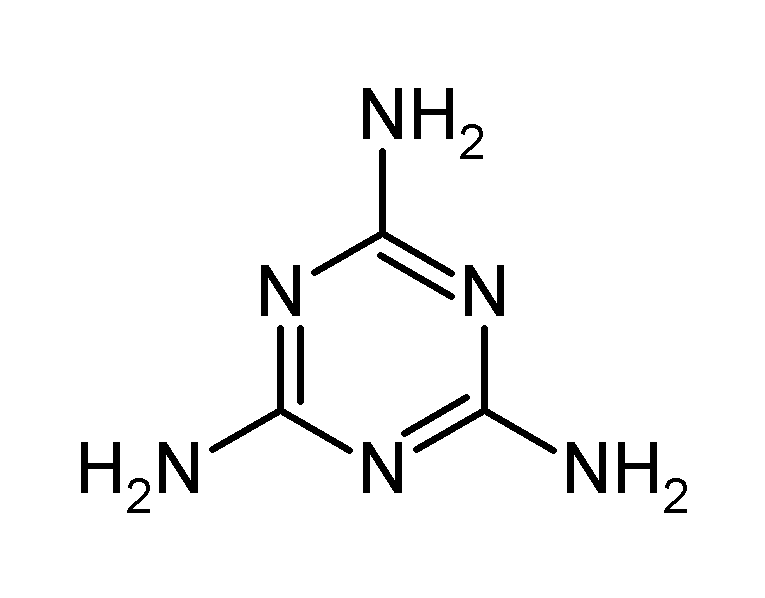
(image from Wikipedia)Is melamine the perfect evil?
The high-protein fake can harm, but beware - there're worse ingredients
By Andy Hor
MELAMINE is a relatively cheap industrial chemical that is readily available, fairly non-toxic, water-soluble and, most significantly, super-rich in nitrogen.
Foods that are high in proteins such as dairy products, wheat and corn gluten, soya and rice protein concentrate, are widely accepted as nutritious, and can command high prices.
Melamine and protein are as different as chalk and cheese.
They do, however, share one common feature - high nitrogen content.
In fact, melamine has more than five times the nitrogen found in proline, a common amino acid in milk proteins (casein).
This was what led to the devious use of melamine as a cheap 'high-protein fake' to falsely boost protein readings.
It has been pumped into everything from milk to pet food ingredients.
One kilogram of melamine costs about $60 in Singapore, but just $2.50 at its source in China. This is enough to dope more than 100,000 litre-cartons of the most contaminated milk found!
The bad news is, melamine is not the only 'non-protein nitrogen'.
Nor is it the worst ingredient you could find.
Other common examples include urea and ammonium nitrate.
There are known cases of urea (and its derivatives) being put illegally into products such as wheat. As for ammonium nitrate, it is used widely as fertiliser and can make its way into the food chain.
Their use as illegal food additives escapes routine detection because many commercial quality control processes merely test for the total nitrogen content of the proteins, not the protein itself. This is because testing proteins is both costly and tedious, particularly since milk has a complex mix of proteins.
This is the root of the problem.
There are established methods to detect melamine and other non-protein nitrogens, but they are not part of routine checks.
Proper milk-testing equipment looks for 'peptide bonds' using a process called spectroscopy as a direct measure of real proteins.
The Food and Agriculture Organisation of United Nations also recommends that the protein content in milk be confirmed by amino acid analysis because testing nitrogen content itself can be misleading.
However, it also says that detection based on total nitrogen content is an 'acceptable' alternative only when good data are not available, because complete protein testing costs more and takes much longer - important considerations for a manufacturer or testing lab.
Melamine is not a potent toxin and many healthy adults can get rid of it by metabolism or passing it out in our urine.
The problem is, break-down of melamine is very inefficient and when it degrades, it gives rise to another nitrogen-containing chemical - cyanuric acid.
Like melamine, its toxicity is low, but when these two combine, they form a crystalline complex that precipitates as a solid.
This can lead to kidney stones, renal failure and death in infants and pets, who are less efficient in getting rid of the chemicals.
A complete ban on melamine would not be the solution, although licensing would be useful.
Its toxicity is not high and it is a useful material for plastic, resins, coating materials, flame retardants and dyes.
More importantly, it is just one of the many nitrogen-rich chemicals known.
It is easily made from urea, which is a common fertiliser. Urea itself comes from ammonia, which is another useful nitrogen compound.
Unlawful use of hydrazine in food would be far worse, since it is a carcinogen. Nearly 90 per cent nitrogen, hydrazine has numerous industrial uses including foaming agents and anti-oxidants.
Cyromazine is another chemical that we should watch out for. It is a derivative of melamine, often used as pesticides and can be taken up by plants as melamine. Its presence in tomato paste is already an issue.
The easy answer is, of course, to widen the net and test for all possibilities, but this is very impractical.
What we should do is to have a balanced approach, taking into account cost, time, manpower and safety, and establish a system to include checks on melamine and its derivatives.
Periodic checks can be done on proteins, especially on high-protein goods, as well as spot checks for other artificial nitrogen enhancers.
We need to better equip our quality assurance labs, both at the factory and distributor levels, and at the enforcement level.
These, however, should not be done at the expense of stifling the business.
We must protect consumers' interest without killing the market.
We can draw comfort from the fact that melamine and its nitrogen-rich relatives are actually 'low-grade' protein counterfeits because chemically, they are very far off from proteins, and can be detected easily by our current armoury of analytical techniques.
We should, however, watch out for the possible event that 'high-quality' fakes are deliberately developed to beat detection techniques.
Vigilance, with the help of science, is our best defence.
The writer is president of the Singapore National Institute of Chemistry, and Head of Chemistry Department at the National University of Singapore.
-------
Latest Consumer Advisory from Agri-Food & Veterinary Authority of Singapore, 9 October 2008:
http://www.ava.gov.sg/NR/rdonlyres/9253E7B2-E57D-4992-982C-1304E73748D6/22223/Pressrelease_Updatesonmelamine_9Oct08website.pdf


(images from Wikipedia)
Tainted milk items in S'pore
With melamine found in candy, Singapore halts sale of all products that may contain China milk
By Tessa Wong & Liaw Wy-cin
WHITE Rabbit Creamy Candy, a milk-based treat popular with children and adults here, has been found to be contaminated with melamine.
The candy joins two other brands - Dutch Lady strawberry-flavoured milk and Yili Choice Dairy Fruit Bar Yoghurt Flavoured Ice Confection - on the list of dairy products from China which the authorities here say are adulterated by the chemical normally found in plastics.
The tainted-milk scandal that originated in China is turning into a global food scare, as governments ban imports and retailers unilaterally take China milk products off the shelves (see list).
In China, four children have died from taking contaminated milk and another 12,892 warded for kidney problems.
Yesterday, a Hong Kong girl found with a kidney stone became the first suspected victim outside mainland China.
Farmers are said to add melamine to diluted milk to artificially raise its protein content.
Coming after a string of scares and general approbation over its safety standards, Chinese Premier Wen Jiabao vowed in a state television broadcast to put an end to such scandals.
But the World Health Organisation (WHO) said yesterday that a quick reaction to the problem by Beijing had been hampered by delays in releasing critical information about the contamination of milk supplies.
WHO's Western Pacific director Shigeru Omi said his group had been helping China to deal with the scandal's fallout and advised Beijing to improve its safety checking and information disclosure systems.
In Singapore, the Agri-Food and Veterinary Authority (AVA) here is taking no chances: Last night, it made it clear that it was suspending the import and sale of any product containing milk from China.
Besides milk and milk products such as ice-cream and yogurt, confectionery items such as chocolate, biscuits, sweets and anything that could contain milk from China came under its latest advisory.
The Straits Times found on Saturday that a 7-Eleven outlet in Braddell had pulled a list of products from its shelves. The list included Snickers bars, M&Ms, Nabisco Chicken In A Biskit, Dove chocolate bars, Mentos yogurt balls, Oreo wafer sticks, and Want Want Take One Baby Bites.
For consumers, reading labels seems advised: A check by The Straits Times last night found that the Snickers and Dove chocolates sold at a 7-Eleven convenience store in Toa Payoh were made in the United States, but those same chocolate brands sold at a neighbouring minimart were labelled 'Product of China'.
The attendant at the minimart said he had not been told anything about chocolates from China, but the shop had stopped selling White Rabbit sweets and Dutch Lady milk last Friday.
FairPrice, the biggest supermarket chain here, said it will be removing confectioneries made with China milk from their outlets from today.
Food science and technology lecturer Dr Leong Lai Peng from the National University of Singapore suggested that consumers buy only food that may contain milk from countries that are major producers of milk, such as Australia.
Avoiding cheap products is also another way. 'With cheap products, there is a chance it is made with milk from a country that sells milk cheaply, such as China,' she said.
Consumers are already wary about processed foods or medicines from China.
Mr Andrew Oh, 38, who works in teleommunications, said: 'That's really scary, it really leads to a confidence loss. We've already been careful about canned food from China after the luncheon meat food scare, now this.'
Meanwhile, a new mother in Chengdu, Sichuan province, sensing a business opportunity amid the tainted-milk scandal has raised controversy by offering in an online advertisement to breast-feed other children - for a price.
The 32-year-old said she has more milk than her three-month-old son can consume and is willing to sell the surplus in a 'breastfeeding service' for 300 yuan (S$63) a day.
Bans and Recalls